
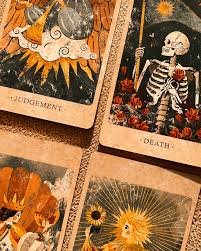
 The Tarot deck is a symbolic system made up of 78 cards that together form a rich, layered map of the human experience. Whilst many people encounter Tarot as a divination tool,
its structure reveals a carefully crafted framework that blends storytelling, psychology, philosophy, numerology, and archetypal symbolism. To understand Tarot is to understand
not only the images themselves but how the deck is organized: the Major Arcana and the Minor Arcana, each serving a distinct role in reflecting the challenges, lessons, and
patterns of life.
The Tarot deck is a symbolic system made up of 78 cards that together form a rich, layered map of the human experience. Whilst many people encounter Tarot as a divination tool,
its structure reveals a carefully crafted framework that blends storytelling, psychology, philosophy, numerology, and archetypal symbolism. To understand Tarot is to understand
not only the images themselves but how the deck is organized: the Major Arcana and the Minor Arcana, each serving a distinct role in reflecting the challenges, lessons, and
patterns of life.
At the heart of the deck are the 22 Major Arcana cards, a sequence of iconic images that represent major life themes, spiritual milestones, and archetypal forces. These cards chart what is often called “The Fool’s Journey,” a symbolic narrative that begins with The Fool, card zero, and follows him as he encounters teachers, trials, insights, joys, disruptions, and transformations. This journey is not literal; rather, it mirrors the unfolding of human growth. Cards like The Magician, The High Priestess, The Empress, and The Emperor depict foundational principles of selfhood and power, whilst cards such as The Chariot, Strength, The Hermit, and The Hanged Man represent stages of determination, introspection, surrender, and resilience. The later cards, Death, Temperance, The Devil, The Tower, The Star, and The Moon, introduce deeper psychological and spiritual processes, ranging from endings and rebirths to temptation, awakening, and illusion. The journey concludes with The Sun, Judgment, and The World, a triad associated with clarity, renewal, and completion. The Major Arcana marks pivotal moments: the times when life shifts direction, when identity evolves, or when the universe seems to nudge us toward growth.
Complementing the Major Arcana are the 56 Minor Arcana cards, divided into four suits that echo the structure of playing cards: Wands, Cups, Swords, and Pentacles. Each suit contains ten numbered cards and four court cards, creating a system that mirrors the daily rhythms and practicalities of life. Where the Major Arcana speaks to overarching events and internal transformations, the Minor Arcana attends to the everyday experiences our relationships, thoughts, conflicts, actions, and ambitions.
The suit of Wands(Click Here for the meaning of each card), traditionally associated with fire, represents creativity, energy, passion, movement, and the spark of inspiration. Wands cards often highlight the forces that push us forward: ambition, desire, confidence, and motivation. Their fiery nature speaks to action, what we pursue, how we express ourselves, and what ignites our spirit. In readings, Wands may refer to new ventures, creative projects, emotional vitality, or the internal fire that fuels personal growth.
The suit of Cups (Click Here for the meaning of each card) corresponds to the element of water and governs emotions, relationships, intuition, and the interior landscape of the heart. Cups reflect the ways we bond with others, the feelings that shape our experiences, and the emotional truths we must confront. These cards often explore love, empathy, dreams, healing, and the subtle currents of spiritual connection. When Cups appear, they frequently point to matters of the heart, both its joys and its challenges.
The suit of Swords (Click Here for the meaning of each card) is aligned with air and represents thought, communication, conflict, clarity, and intellectual processes. Swords cards highlight the role of the mind, our beliefs, judgments, fears, decisions, and the ways we communicate with the world. Because the mind can both empower and entangle us, Swords often explore dualities: truth versus illusion, courage versus doubt, action versus hesitation. They frequently appear during times of tension, problem-solving, or breakthroughs.
Finally, the suit of Pentacles (Click Here for the meaning of each card), ruled by the element of earth, reflects the physical and material aspects of life: security, stability, health, home, skill-building, and long-term effort. Pentacles speak to grounding, the practical steps we take to build a meaningful and sustainable life. They often address themes such as responsibility, resources, discipline, and the tangible outcomes of our actions.
Within each suit, the ten numbered cards represent a cycle—from the Ace, which introduces the pure essence of the suit’s element to the Ten, which completes the journey with fulfillment, culmination, or closure. These cycles mirror the natural phases of growth: beginnings, challenges, development, crisis, mastery, and resolution. The numbered cards reflect life as we experience it day to day: dynamic, shifting, and influenced by countless small choices.
The court cards (Page, Knight, Queen, and King) add another layer of meaning. These cards may represent people, personality traits, stages of maturity, or energetic archetypes. Pages are youthful learners, Knights are active and quest-driven, Queens embody emotional or intuitive mastery, and Kings represent leadership, direction, and authority. Each court card expresses the characteristics of its suit, offering insight into how different forms of energy appear in real life.
Together, the Major and Minor Arcana create a complete symbolic universe. The Major Arcana shows the broader themes that define a person’s life path, Whilst the Minor Arcana depicts the subtle movements of everyday life. One offers the structure of myth; the other offers the texture of experience. When woven together in a reading, they form a layered, multifaceted story, one that reflects not just events, but emotions, motives, psychology, and potential.
The Tarot, in its structure, becomes more than a deck of cards. It becomes a mirror, a narrative, and a guide. Through its archetypes and its suits, it offers a language for understanding the complexities of being human.

The Boston Horoscope is the work of Dr. Elliot Voss, an internationally renowned astrologer/astrologist who has been studying the heavens for over forty years.
© Copyright 2025, All Rights Reserved, Elliot Voss | terms & privacy