
 Tarot decks, now widely associated with divination, personal insight, and spiritual exploration, began their journey in a far more earthly form. The earliest Tarot
cards emerged in the mid-15th century in northern Italy as part of a fashionable and sophisticated card game called trionfi, or triumphs. Wealthy families
commissioned lavish hand-painted decks that blended Christian iconography, courtly symbolism, and allegorical figures reflecting the moral and cultural concerns
of the Renaissance. These early creations eventually evolved into what we know today as the Major and Minor Arcana, though originally they were used not for
fortune-telling but for entertainment, storytelling, and social play. Only centuries later would Tarot become the spiritual tool we now recognize.
Tarot decks, now widely associated with divination, personal insight, and spiritual exploration, began their journey in a far more earthly form. The earliest Tarot
cards emerged in the mid-15th century in northern Italy as part of a fashionable and sophisticated card game called trionfi, or triumphs. Wealthy families
commissioned lavish hand-painted decks that blended Christian iconography, courtly symbolism, and allegorical figures reflecting the moral and cultural concerns
of the Renaissance. These early creations eventually evolved into what we know today as the Major and Minor Arcana, though originally they were used not for
fortune-telling but for entertainment, storytelling, and social play. Only centuries later would Tarot become the spiritual tool we now recognize.
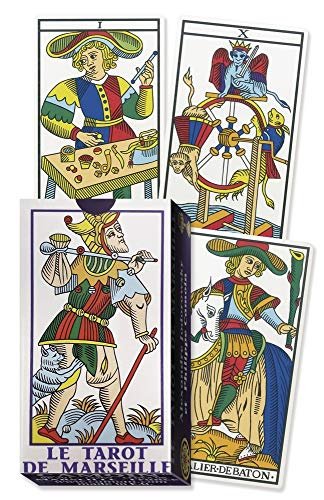
The best-known historical Tarot deck is the Tarot de Marseille, which emerged in the 16th and 17th centuries in France and Switzerland. It became the standard pattern for European decks and remains one of the most influential designs in the history of Tarot. The Marseille deck’s sharp lines, primary colors, and woodcut style reflect the printing technologies of its era, and the figures, such as The Magician, The Hermit, and The Lovers, established visual archetypes that many later decks would reinterpret. Notably, in the Marseille tradition the Minor Arcana are illustrated with simple arrangements of suit symbols rather than full narrative scenes, giving the deck a more abstract and meditative energy.
The shift from Tarot as a game to Tarot as a mystical tool began in the late 18th century, when French occultists such as Antoine Court de Gébelin and Etteilla claimed that the cards preserved ancient Egyptian wisdom. Though historically inaccurate, their theories sparked growing interest in Tarot as a symbolic and esoteric system. This reinterpretation paved the way for the next major development: the creation of the Rider–Waite–Smith (RWS) Tarot in 1909.
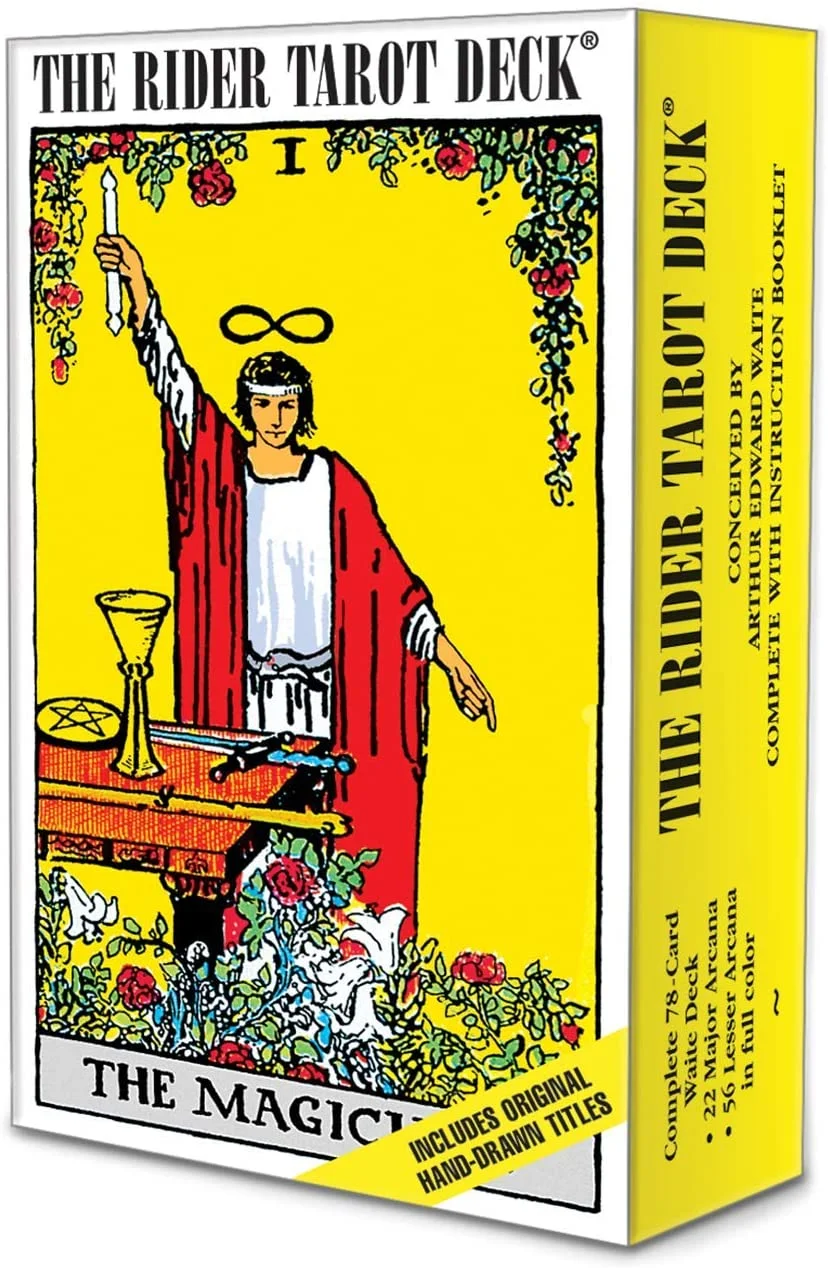 Commissioned by the Hermetic Order of the Golden Dawn and illustrated by Pamela Colman Smith under the guidance of Arthur Edward Waite, the RWS deck
revolutionized Tarot. For the first time in modern history, every card (not just the Major Arcana,
but especially the Minor Arcana, featured a detailed narrative illustration rather
than simple suit symbols. This visual storytelling made the deck intuitive and accessible, and it soon became the most widely used Tarot deck in the world.
Today, countless modern decks trace their symbolism, structure, and interpretive style back to the Rider–Waite–Smith tradition.
Commissioned by the Hermetic Order of the Golden Dawn and illustrated by Pamela Colman Smith under the guidance of Arthur Edward Waite, the RWS deck
revolutionized Tarot. For the first time in modern history, every card (not just the Major Arcana,
but especially the Minor Arcana, featured a detailed narrative illustration rather
than simple suit symbols. This visual storytelling made the deck intuitive and accessible, and it soon became the most widely used Tarot deck in the world.
Today, countless modern decks trace their symbolism, structure, and interpretive style back to the Rider–Waite–Smith tradition.
Another major lineage emerged slightly later with the creation of the Thoth Tarot, developed by Aleister Crowley and illustrated by Lady Frieda Harris. Published after both artists’ deaths, the Thoth deck blends hermetic Kabbalah, astrology, numerology, and Thelemic philosophy into a richly symbolic system. While the RWS deck emphasizes narrative scenes, the Thoth deck uses geometric shapes, color theory, and esoteric symbolism to evoke archetypal energies. Many readers find the Thoth deck more abstract, psychological, or intellectually challenging, and for that reason, deeply rewarding.
Alongside these traditions, the Lenormand decks occupy their own parallel history. Named after French fortune-teller Marie Anne Adelaide Lenormand (1772–1843), these decks are not technically Tarot but often included in the broader family of carto mantic tools. Lenormand cards typically include 36 images, like The Fox, The Ship, or The Ring,each interpreted in pair-based combinations. Their style is more direct and predictive than Tarot, offering clear, practical readings rather than symbolic or introspective ones.
In the 20th and 21st centuries, Tarot has expanded into an extraordinary variety of artistic and cultural expressions. Modern creators design decks that reflect diverse mythologies, spiritual traditions, and personal identities. Today you can find animal-themed decks, astrological decks, goddess decks, shadow-work decks, pop-culture decks, and even decks centered on psychological introspection or mindfulness. Some artists follow the classic RWS structure closely; others reinvent the archetypes entirely, offering new interpretations of familiar themes like rebirth, transformation, intuition, and self-identity.
The rise of digital technology has also ushered in digital Tarot decks and mobile Tarot apps, making readings accessible to a global audience. While traditionalists prefer the tactile experience of physical cards, digital decks have introduced Tarot to people who might never have picked up a physical deck before, expanding the practice into new realms of accessibility and creativity.
Despite their differences, all Tarot decks share a common thread: they serve as mirrors of the human experience. Whether rooted in Renaissance art, Golden Dawn occultism, modern psychology, or cultural storytelling, Tarot decks allow readers to explore the connection between imagery and intuition. The symbols, whether minimalistic like the Marseille or richly illustrated like the RWS, act as gateways into understanding patterns, emotions, choices, and inner truths.
From 15th-century card tables to 21st-century meditation spaces, Tarot’s history tells a story of continual evolution. As the world has changed, so have the ways readers connect with the cards, making Tarot one of the most enduring and adaptable symbolic systems in human culture. Whether approached as a spiritual practice, a psychological tool, or a contemplative art form, Tarot remains a living tradition, one that continues to grow with every new deck that enters the world.

The Boston Horoscope is the work of Dr. Elliot Voss, an internationally renowned astrologer/astrologist who has been studying the heavens for over forty years.
© Copyright 2025, All Rights Reserved, Elliot Voss | terms & privacy